
Rituximab Biosimilar PK Monitoring
Most conversations about biosimilar PK monitoring treat the molecule as the starting point.
Identify the drug.
Select an assay validated for that drug.
Run the study.
For Rituximab, that logic breaks down at the second step.
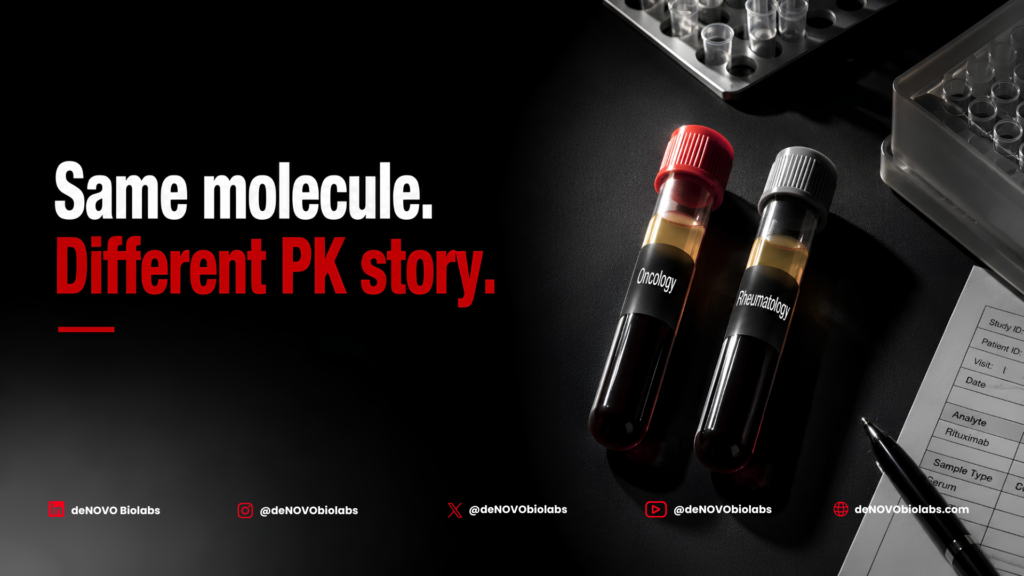
Because Rituximab is not one clinical story. It is at least two, and the PK implications of those two stories are different enough to matter when you are selecting and validating your assay.
Rituximab across indications:
Rituximab is an anti-CD20 chimeric monoclonal antibody. In oncology, it is used in Non-Hodgkin lymphoma, chronic lymphocytic leukemia, and diffuse large B-cell lymphoma, typically administered intravenously at 375 mg/m² on a schedule that varies by protocol.
In autoimmune disease, it is used in rheumatoid arthritis, granulomatosis with polyangiitis, and microscopic polyangiitis, at lower doses and longer intervals.
The serum concentration profiles generated by these two dosing regimens are different.
Oncology programs produce higher peak concentrations and a concentration-versus-time curve shaped by the intensity of dosing.
Rheumatology programs run lower doses over longer maintenance intervals.
Trough concentrations, which are clinically important for both efficacy and safety monitoring, sit at different absolute levels depending on which indication and protocol you are measuring.
If your PK assay was chosen and validated without reference to your specific indication and dosing protocol, there is a real risk that your assay range does not fit your expected concentration window.
An assay that works cleanly in the mid-range of an oncology dosing curve may not have adequate sensitivity at the trough levels relevant to a rheumatology maintenance protocol.
Why the assay format matters?
The DeQuanto Rituximab PK ELISA uses an anti-Rituximab antibody pre-coated sandwich format. The Rituximab in the sample binds to the plate. HRP-labeled antibody detects the captured drug. The signal develops in proportion to the Rituximab concentration in the sample. Absorbance is read at 450nm and concentration is interpolated from the standard curve.
The critical design consideration in this format is the specificity of the capture antibody. Rituximab is a chimeric antibody with human constant regions. This means any capture antibody without precise specificity can pull down endogenous immunoglobulins from the patient serum alongside the drug, generating background signal that distorts quantification.
Screening capture antibody candidates against the drug in actual patient serum matrices, not just purified drug in buffer, is how that problem is prevented.
The antibodies used in the DeQuanto Rituximab kit are developed in-house at our Bangalore facility and screened for specificity in human serum and plasma, the matrices the assay is validated for use in.
Assay specs:
DeQuanto Rituximab PK ELISA Kit, Cat# PK1004.
Assay range: 6.25 to 200 ng/ml
Sensitivity: 6.25 ng/ml
Assay format: Indirect sandwich
CV: Less than 20% intra-assay and inter-assay
Matrix: Human serum and plasma
Storage: Shipped at 2 to 8 degrees Celsius, long-term at minus 20 degrees Celsius
Regulatory: For research use only
Before committing this range to your study, confirm that your expected trough and peak concentrations based on your specific dosing protocol fall within the 6.25 to 200 ng/ml window. If your study design generates concentrations outside this range, discuss sample dilution strategies or assay modifications with our technical team before validation begins.
When to make this decision?
The right time to finalise your Rituximab PK assay is before your clinical study protocol is locked.
Not before filing.
Not after the first samples arrive.
Before the protocol, because the protocol defines the dosing schedule that defines the expected concentration window that defines the assay range requirement.
If your Rituximab biosimilar program is at the stage where PK assay selection needs to happen, write to us to discuss your specific study design.
📧 info@denovobiolabs.com
📞 +91 80 29575711