
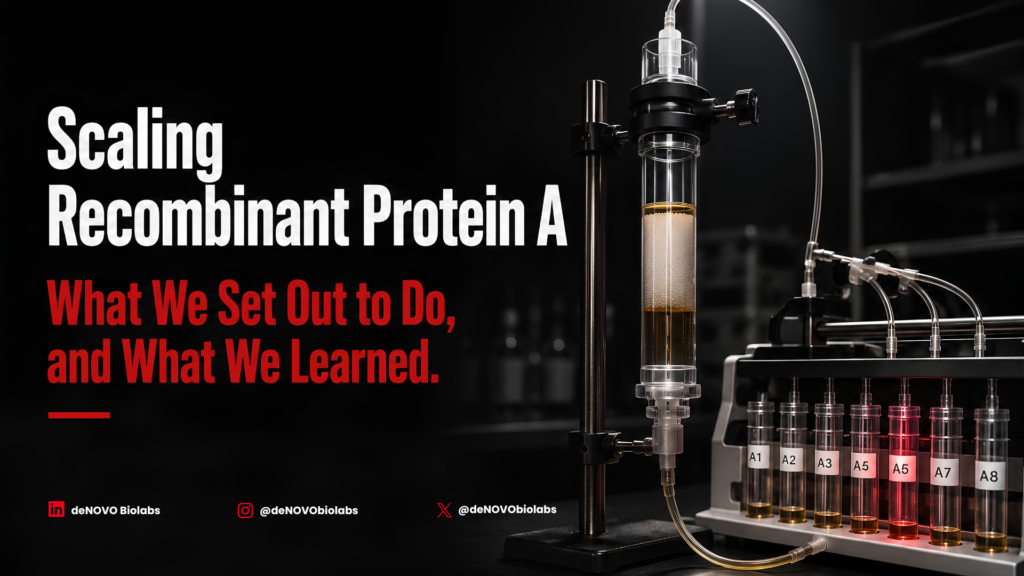
Most updates about production milestones sound like success stories written after the fact, once everything already works. This one is written closer to the middle of the process, because that is where the more useful lessons usually are.
What we set out to do?
Protein A is used across diagnostic and biosimilar workflows, most commonly in affinity purification for antibody-based products, and as a reagent in ELISA and diagnostic kit development. Diagnostic manufacturers building antibody-based tests need a reliable, consistent supply of it. Historically, much of that supply in India has been imported.
Our goal was straightforward on paper: take a recombinant Protein A expression system already validated at research scale in our lab, and scale it up to production volumes using the large-scale culture and purification infrastructure we have been building at our Bangalore facility, including our automated protein purification system and bacterial and cell culture bioreactors.
What actually happened?
Scaling any recombinant protein from research to production volume is not a linear operation. The expression construct that performs well in a small culture does not automatically behave the same way at larger scale. Growth conditions, induction timing, and downstream purification steps all interact differently once volume increases.
Our purification approach for Protein A follows the standard sequence used across the industry: affinity chromatography as the primary capture step, followed by additional polishing steps such as ion exchange or size exclusion depending on the purity specification required. At production scale, each of these steps has to be re-verified. A chromatography method that gives clean separation at a small column volume can behave differently once you scale the column and the load.
We also had to build in orthogonal quality control at every stage, not just at the final product. SDS-PAGE and structural checks confirm the protein is correctly folded and intact. Functional assays confirm the protein performs the way a diagnostic manufacturer actually needs it to, in real ELISA and binding conditions, not just in a purity test.
Endotoxin control is a separate and important part of this, particularly for expression systems where that risk is higher. It is one of the steps that adds time to a production run, and one we do not shortcut.
What we learned?
The biggest lesson so far has been about sequencing. It is tempting to treat scale-up as a single jump from bench to production. In practice, it works better as a series of smaller, deliberate steps, each one validated before moving to the next volume. That is slower. It is also the only way we have found to catch a problem while it is still small and inexpensive to fix, rather than after it has propagated through an entire production batch.
The second lesson has been about what “consistent” actually means in practice. It is not enough for one batch to meet specification. The value to a diagnostic manufacturer is knowing that batch ten will perform the same way as batch one. Building that confidence takes more repeated runs than most people expect, and more documentation of what stayed the same and what had to be adjusted along the way.
Where this leaves us?
This work is ongoing. We are not presenting it as a finished success story, because it is not finished. We are sharing it because the honest version of a production scale-up, including the parts that took longer than planned, is more useful to other teams facing the same problem than a polished announcement would be.
If your team works with recombinant protein production, purification, or diagnostic antigen reagents and wants to talk through what scale-up actually involves, write to us.
📧 info@denovobiolabs.com
📞 +91 80 29575711
🌐 denovobiolabs.com