
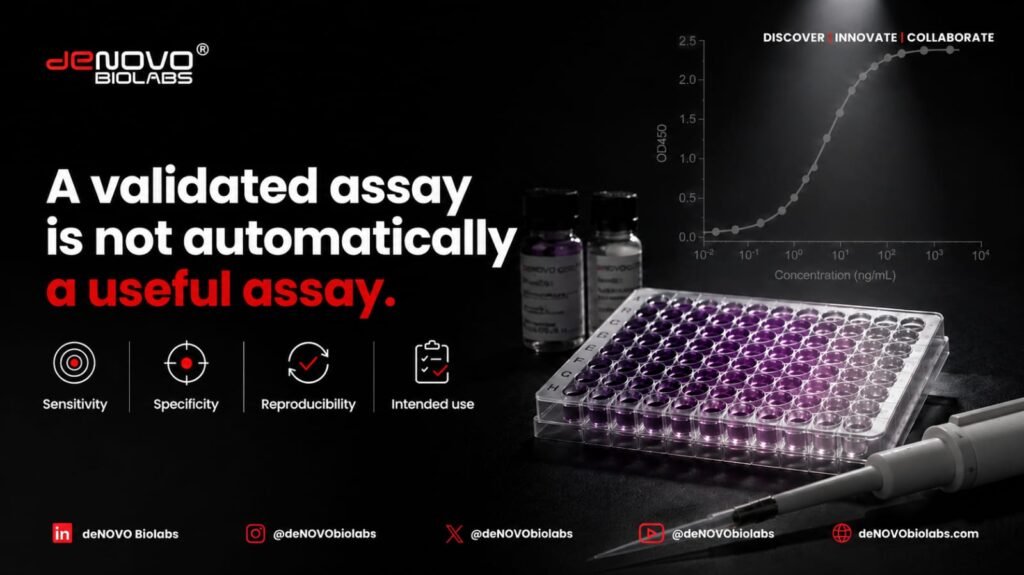
A validated assay can still be the wrong assay.
This is one of the most important distinctions in analytical development.
Validation tells you if a method performs against predefined criteria.
It does not tell you whether the method is appropriate.
For biosimilar development, this distinction is super important.
The goal is not simply to generate analytical data.
The goal is to generate reliable data that can support a comparability decision.
So the better question is not:
“Is the assay validated?”
It is:
“Is the assay fit for the purpose it is being used for?”
At deNOVO Biolabs, we believe assay development should start with that question.
What does Fit-for-Purpose mean?
A fit-for-purpose assay is a method designed around its intended use, sample type, expected concentration range and the decision the resulting data needs to support.
The requirements for a PK assay are not necessarily the same as those for a product-characterization assay.
An assay used during early development may also have different requirements from one supporting a regulated study or batch-release decision.
This is why assay selection should not begin with a specification sheet.
It should begin with the question:
What are we trying to demonstrate?
For biosimilar development, analytical methods need to be scientifically appropriate for the characteristics being assessed and capable of generating meaningful, reliable data.
This distinction changes how we approach assay development.
1. Start with the decision, not the assay
Before selecting an assay, define what the result needs to tell you.
Is the assay being used for:
- Pharmacokinetic monitoring?
- Immunogenicity assessment?
- Product characterization?
- Comparability?
- Potency?
- Process monitoring?
- Batch release?
- Stability?
Each application creates different analytical requirements.
For example, a PK assay needs to reliably quantify the analyte across the expected concentration range in the relevant biological matrix.
A functional assay may need to demonstrate biological activity.
A comparability assay may need sufficient discriminatory capability to identify meaningful differences between a biosimilar and its reference product.
The method should follow the question.
Not the other way around.
A practical rule
Before asking which assay to use, define:
Purpose → Sample → Decision → Required performance
This simple exercise can eliminate unsuitable methods before significant development work begins.
2. The right Analyte in the wrong Matrix is still the wrong measurement
An assay can perform well under controlled conditions and behave differently in real samples.
Biological matrices contain components that can interfere with analytical measurements.
That is why matrix suitability needs to be considered during development, not discovered at the end.
For a quantitative ELISA, relevant questions include:
- Does the matrix affect recovery?
- Is dilution behaviour acceptable?
- Is the assay sufficiently specific?
- Is background controlled?
- Does the calibration range cover expected samples?
- Does performance remain consistent across relevant sample conditions?
These questions become especially important when moving from development samples to study samples.
The practical takeaway:
Do not develop the assay around the easiest sample.
Develop it around the sample the assay will actually need to measure.
3. Sensitivity does not make an assay better
Sensitivity is often one of the first specifications scientists compare.
But the lowest detectable concentration is not necessarily the most important number.
An assay can have excellent sensitivity and still be unsuitable because of:
- High background
- Poor precision
- Limited dynamic range
- Matrix interference
- Weak reproducibility
- Poor performance at relevant concentrations
The more useful question is:
Can the assay reliably measure the concentrations that matter for the study?
That means evaluating sensitivity alongside precision, specificity, range, matrix performance and reproducibility.
This is particularly important for quantitative bioanalysis, where samples may span a wide concentration range.
A lower LLOQ is useful only when the assay can maintain reliable performance around that range.
Do not optimise one number at the expense of the method.
4. Can the assay detect the difference?
This question becomes particularly important in biosimilar development.
The purpose of analytical comparability is not simply to show that two products can be measured.
It is to generate evidence about their similarity.
This creates an important assay-development question:
Is the method capable of detecting a meaningful difference?
An assay can be highly reproducible and still have limited value if it cannot distinguish the change relevant to the scientific question.
This is where analytical development becomes more than method validation.
The method itself becomes part of the comparability strategy.
5. Control variability before interpreting similarity
Analytical variability matters because it affects what you can conclude from the data.
If method variability is high, a genuine difference may become difficult to distinguish from analytical noise.
For a biosimilar program, teams should consider variability across relevant sources, including:
- Analysts
- Runs
- Plates
- Reagent lots
- Sample matrices
- Reference materials
- Time points
The exact study design will depend on the intended use and applicable validation requirements.
But the principle remains the same:
You cannot interpret similarity confidently if you do not understand the variability of the measurement.
A Simple Framework for Assay Selection
Before committing to an analytical method, evaluate it through five questions:
| Question | What to ask? |
| Purpose | What decision will this result support? |
| Sample | Can the method reliably handle the actual matrix and concentration range? |
| Performance | Does it meet the required sensitivity, precision, specificity and range? |
| Discrimination | Can it detect the differences that matter? |
| Reproducibility | Will the result remain reliable across relevant sources of variation? |
This is the difference between selecting an assay because it works and selecting one because it fits the job.
The deNOVO Perspective
At deNOVO Biolabs, we see assay development as more than achieving a set of validation parameters.
The method needs to make scientific sense for the application.
This means considering the molecule, the matrix, the expected concentration range, the intended use and the decision the data needs to support.
A good assay should not simply produce a number.
It should produce a number you can interpret with confidence.
As biosimilar development moves toward more detailed analytical characterization and comparability, that distinction becomes increasingly important.
FAQs
What is a fit-for-purpose assay?
A fit-for-purpose assay is an analytical method developed and evaluated according to its intended use, sample characteristics and the decision its results need to support.
Does assay validation prove that an assay is fit for purpose?
No. Validation demonstrates that a method meets predefined performance criteria. Suitability also depends on whether the method itself is appropriate for the intended application.
What are the key parameters for assay validation?
Depending on the method and intended use, these may include accuracy, precision, specificity, sensitivity, range, stability, matrix effects and reproducibility. The appropriate parameters depend on the application.
Why is assay variability important in biosimilar development?
Analytical variability can make it harder to distinguish meaningful differences between a biosimilar and its reference product. Understanding and controlling method variability improves confidence in the resulting comparison.
How should I choose an ELISA for bioanalysis?
Start with the intended application and sample type. Then evaluate sensitivity, specificity, precision, range, matrix compatibility, reproducibility and other requirements relevant to the study.
Avoid choosing an assay based on sensitivity or price alone.
Conclusion
A validated assay is an important milestone.
It is not the finish line.
For biosimilar development, the better question is whether the analytical method is fit for the scientific decision it needs to support.
Start with the purpose.
Understand the sample.
Define the required performance.
Assess whether the method can detect the differences.
Then validate it against those requirements.
The best assay is not necessarily the most sensitive assay.
It is the assay that produces reliable evidence for the decision you need to make.
At deNOVO Biolabs, we work with biopharma and bioanalytical teams on quantitative PK ELISA, immunogenicity assays, custom ELISA development and related analytical solutions.
If you are developing a biosimilar and evaluating an analytical method, speak with our scientific team about your specific assay requirements, application and development stage.
Let’s determine what the assay needs to prove before deciding what the assay needs to be.