
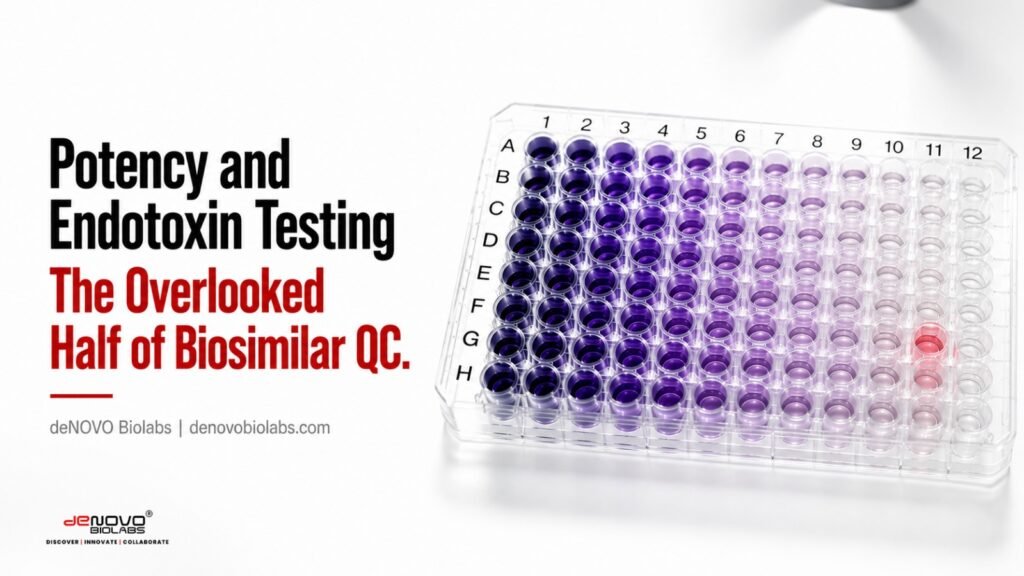
Most conversations about biosimilar analytical development focus on pharmacokinetics and immunogenicity, and for good reason. Both are central to demonstrating comparability. But a QC package is not complete without two other checkpoints that get far less attention: potency testing and endotoxin testing.
What does Potency Testing confirm?
Potency testing answers a different question than concentration testing. Knowing that a drug is present at the correct concentration does not confirm that it behaves the way it should biologically. Potency testing, commonly performed using an MTT assay measuring cell viability and biological response, confirms that the molecule actually triggers the intended biological activity.
The MTT assay itself is a well-established method, in use for decades across pharmaceutical and diagnostic research. That familiarity is exactly what makes it easy to underestimate. Running an MTT assay that gives a number is straightforward. Running one that gives a number you can defend under regulatory scrutiny requires real assay development work: the right biological system for the specific molecule, appropriate controls, and validated acceptance criteria tailored to the product.
What does Endotoxin Testing confirm?
Endotoxin testing answers a completely separate question from potency. It has nothing to do with whether the drug works. It confirms whether the product is safe to administer at all, independent of biological activity.
Like the MTT assay, endotoxin testing methods are standardised and well understood across the industry. The variable that determines whether a result is reliable is execution: how carefully the assay is validated for the specific product matrix being tested, since interference from formulation components is a known and common source of unreliable results if not properly accounted for.
Why are they deprioritised?
Neither potency nor endotoxin testing has the same visibility in biosimilar development conversations as PK or immunogenicity work. They are older methods, considered routine, and easy to treat as a checklist item rather than a genuine analytical checkpoint.
That treatment is where problems surface. A regulatory reviewer evaluating a submission does not treat potency or endotoxin data as secondary. Gaps or inconsistencies in either can stop a submission just as effectively as a gap in PK or immunogenicity data.
How deNOVO supports this?
Potency testing and endotoxin testing are part of deNOVO’s Cell Based Assays service line, alongside pharmacokinetics and immunogenicity method development and validation, anti-drug antibody development, neutralizing antibody development and characterisation, and drug pharmacopeia studies.
If your program’s QC plan includes these as line items without dedicated development and validation behind them, it is worth revisiting that plan before a regulatory reviewer does.
📧 info@denovobiolabs.com
📞 +91 80 29575711
🌐 denovobiolabs.com