
When you ask most people, why so few companies in India develop antigens and antibodies indigenously, the assumption is usually about raw material access.
This is not actually the constraint.
The real barrier is expertise, and expertise takes years to build.
What indigenous development requires?
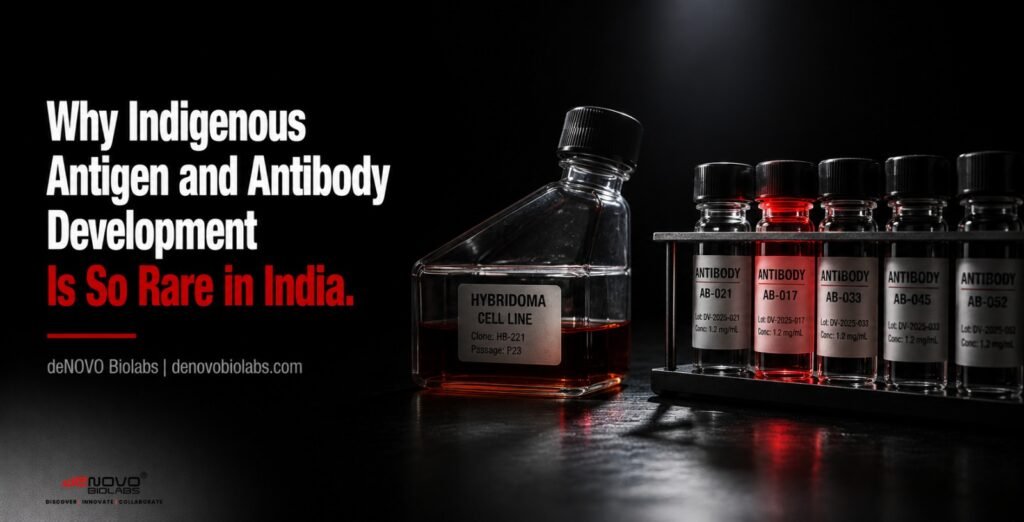
Building an antibody from scratch starts with clone development, the biological work of producing a cell line that secretes the target antibody. That clone then has to be characterised in detail: what it produces, how consistently, and how specific it is to the target without cross-reacting elsewhere.
None of this can be shortcut. A clone that looks promising in early screening can behave differently once tested against the actual application it’s meant for. Getting the characterisation right, before ever scaling production, is what determines whether the eventual antibody is reliable.
Most companies working in this space in India address the challenge in one of two ways. They license bioprocessing and development technology from an international provider, or they outsource the work entirely to a contract manufacturer.
deNOVO chose a third path starting in 2013: building the capability in-house, from clone development through to characterisation and, more recently, production-scale culture.
Why this matters beyond one company?
Indigenous antigen and antibody development supports more than deNOVO’s own product range. It also underpins work with research institutions across India on projects where the explicit goal is reducing dependency on imported materials for future research and development.
Some of this work involves confidential collaborations that can’t be discussed in detail. The consistent thread across all of it is the same: build the material here, so critical research doesn’t depend on a supply chain outside the country.
What it took to build this?
There was no established playbook for this in India when deNOVO started. Standards for what counted as sufficient specificity, acceptable cross-reactivity, or consistent lot-to-lot performance had to be defined internally, based on years of characterisation work across many clones and many projects.
That is the part of the process that doesn’t get much visibility. It also happens to be the part that makes the eventual capability real, rather than something written in a proposal.
If your team is evaluating indigenous antigen or antibody development for a research, diagnostic, or biosimilar application, write to us.
📧 info@denovobiolabs.com
📞 +91 80 29575711
🌐 denovobiolabs.com