
Why the Assay design starts with the molecule?
Most biosimilar PK monitoring conversations in India focus on monoclonal antibodies. Adalimumab, Rituximab, Bevacizumab. These are the molecules with the largest development pipelines and the most published assay validation data.
Etanercept gets less attention in the PK monitoring discussion, which is surprising given how active the rheumatoid arthritis biosimilar space is in India. Multiple companies have programs at various stages. The reference product patent landscape is well-established. Regulatory guidance for autoimmune biosimilars is clear.
The PK assay conversation for Etanercept is different from that of monoclonal antibodies in one important way. Understanding that difference is where good assay design starts
What is Etanercept?
Etanercept is not a monoclonal antibody. It is a fusion protein, specifically a dimer of two human p75 TNF receptor domains fused to the Fc region of human IgG1. It works by binding soluble TNF-alpha and TNF-beta with high affinity, preventing these cytokines from interacting with their cell surface receptors and triggering the inflammatory cascade that drives rheumatoid arthritis pathology.
This structural and mechanistic distinction matters for PK assay design in a specific way. The same binding interaction that defines Etanercept’s pharmacological mechanism, its high-affinity TNF-alpha binding, is also the most natural basis for detecting the drug in a patient serum sample.
Why capture antigen choice is important?
In an indirect ELISA format for PK monitoring, the capture antigen immobilised on the plate determines what the assay selectively binds from a complex serum sample. For Etanercept, using recombinant human TNF-alpha as the capture antigen means the assay captures the drug through the same binding domain that makes it pharmacologically active.
This has a practical consequence. You are detecting the fraction of Etanercept that retains TNF-alpha binding capability, which is the fraction that is pharmacologically relevant. A capture design that uses an anti-Etanercept antibody directed at a different region of the molecule may detect total drug but will not distinguish active from inactive or degraded drug in the same way.
For biosimilar comparability studies, where you are comparing the PK profile of your biosimilar against the reference product in the same patient population, detecting the pharmacologically relevant form of the drug is the scientifically defensible approach.
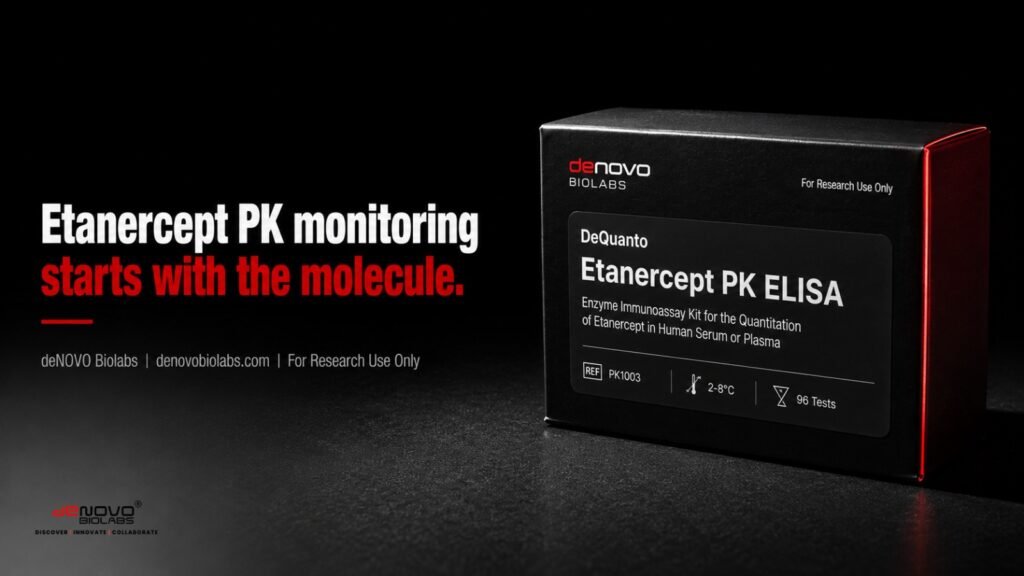
The DeQuanto Etanercept PK ELISA
At deNOVO Biolabs, the DeQuanto Etanercept PK ELISA Kit (Cat# PK1003) is built on the TNF-alpha capture principle. Recombinant human TNF-alpha is pre-coated on polystyrene microtiter plates. Etanercept present in the sample binds to the TNF-alpha. Non-bound material is removed by washing. HRP-labeled antibody is added to detect the TNF-alpha/Etanercept complex. Following a further wash, substrate solution is added and colour develops in proportion to the amount of Etanercept in the sample. The stop solution is added and absorbance is read at 450nm. Concentration is interpolated from the standard curve.
Assay range: 2.34 to 300 ng/ml
Sensitivity: 2.34 ng/ml
Accuracy and precision: CV below 20% intra-assay and inter-assay
Matrix: Human serum and plasma
Storage: Shipped at 2 to 8 degrees Celsius, long-term storage at minus 20 degrees Celsius
Regulatory status: For research use only
The kit is available as Cat# PK1003 in standard format and Cat# PK1003-ST.
Manufactured in-house at our Electronics City, Bangalore facility.
Delivered across India in 1 to 2 weeks.
When to select your PK assay?
The poll we ran recently asked biosimilar developers at what stage their programs typically lock in PK assay selection. The most honest answer from most teams is later than it should be.
For Etanercept programs, the right time to finalise the assay is before the first clinical batch is manufactured and certainly before the clinical study protocol is locked. The assay needs to be validated in the sample matrix from your clinical study, which means human serum or plasma from the patient population being dosed. Designing and validating the assay after clinical samples already exist is a sequencing problem that adds time and cost at a stage where neither is available.
The assay range also needs to match your expected serum concentration profile. Etanercept dosing for rheumatoid arthritis typically produces trough and peak concentrations in a range that the DeQuanto kit’s 2.34 to 300 ng/ml window covers well. Confirming this against your specific study design before validation begins is the first conversation worth having.
If your Etanercept biosimilar program is approaching the PK assay selection stage, write to us to discuss what a fit-for-purpose design looks like for your protocol.
📧 info@denovobiolabs.com
📞 +91 80 29575711