
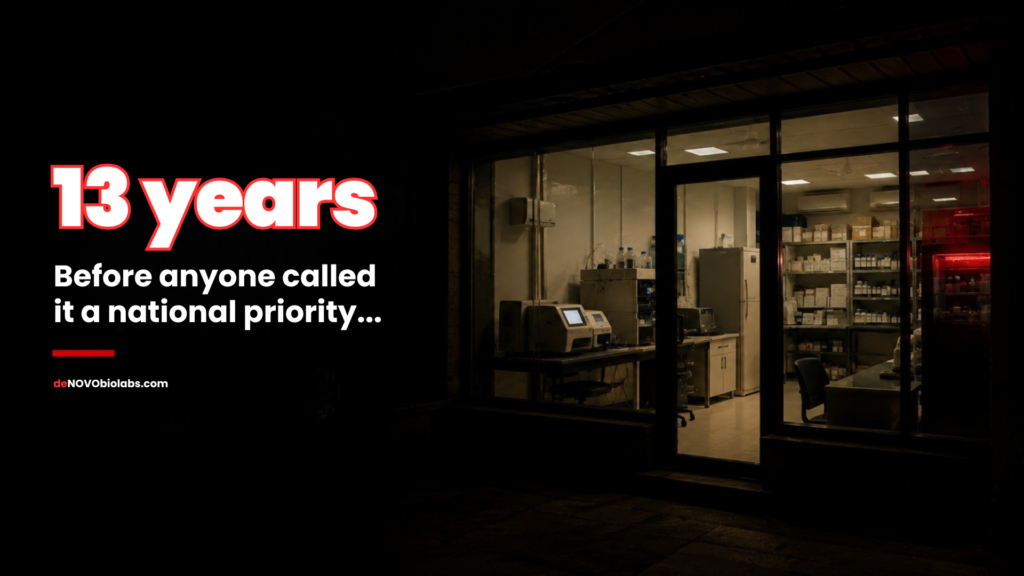
When the Government of India announced Biopharma SHAKTI in the Union Budget 2026 – a ₹10,000 crore national investment to strengthen India’s biologics and biosimilars manufacturing ecosystem – it was described as a turning point for Indian biopharma.
For us, it felt like something different.
A confirmation.
We have been building exactly what Biopharma SHAKTI is designed to fund, since 2013.
Not because we anticipated the policy.
But because we saw the problem clearly & nobody else was doing anything about it.
What 2013 actually looked like?
India’s biosimilar industry in 2013 was moving. Companies were developing molecules. Clinical programs were progressing. The regulatory framework under CDSCO was maturing. On the surface, the industry was building.
But underneath, the analytical infrastructure was almost entirely imported.
If you were a QC team at a biosimilar company in Bangalore or Hyderabad in 2013, your ELISA kits for pharmacokinetics and immunogenicity testing were coming from the United States or Europe.
Six to eight week lead times.
Technical support running through time zones.
Kits validated for their markets, not necessarily for the E. coli strains and process conditions Indian manufacturers actually worked with.
The dependency was not a secret. It was simply not a priority for anyone to solve.
Dr. Dinesh K Saini and Dr. Manjunath S Devaramani, part of one of Karnataka’s earliest startup cohorts supported by BIRAC and the Vision Group of Karnataka, decided to make it their priority.
The founding question was simple:
If India is building biosimilars, why is the testing infrastructure being imported?
Building what didn’t exist:
The early years of deNOVO were not easy in the way most startup stories describe. The challenge was not funding, though that was real. The challenge was credibility.
When you are asking a biosimilar QC team to use your ELISA kit for an assay that feeds directly into their regulatory submission, you are asking them to stake something on a company they have never heard of. In a field where the default is a global brand with decades of validation data behind it, that is a significant ask.
Trust in this industry is earned one customer at a time, over years. You earn it by showing up when something doesn’t work as expected. By answering the call when a batch is failing and the team needs a scientist, not a ticket number. By building a kit that actually performs in the matrix conditions of Indian biosimilar manufacturing, not in the idealised conditions of a catalogue validation study.
That is what deNOVO built.
Not a cheaper version of an imported kit.
An indigenously developed, in-house manufactured, process-relevant alternative with the kind of support infrastructure that a global supplier operating from another continent simply cannot provide.
What consistency looks like under pressure?
In 2020, the pandemic tested every supply chain assumption the Indian biotech industry had made.
1. Critical reagents from overseas suppliers stopped moving.
2. Customs clearance became unpredictable.
3. Cold chain logistics broke down across international routes.
Labs that had built programs around imported reagents found themselves unable to continue work that had no domestic alternative.
During that same period, deNOVO received supply requests from multiple COVID vaccine development programs in India – volumes and timelines that stretched what a company of our size had previously handled.
We said ‘yes’ and we delivered!
Every batch identical in quality to the last. No deviations. No missed commitments. During a national lockdown.
That is what indigenous manufacturing means in practice. Not just cost or lead time – though both matter. It is the difference between having options when a country needs something critical and not having them.
Our Milestones
In 2018, deNOVO received the Bio-Excellence Emerging Company Award at the Bengaluru Tech Summit from the Government of Karnataka. In 2019, we represented India at BIO 2019, the world’s largest biotech conference, as part of Karnataka’s biotechnology delegation.
Today, 6 of India’s top 10 biosimilar companies trust our kits. Our DeQuanto ELISA platform covers pharmacokinetics monitoring for Infliximab, Adalimumab, Etanercept, Rituximab, Bevacizumab, Ranibizumab, Denosumab, and Nivolumab, alongside immunogenicity kits and our E. coli HCP ELISA. Our Adalimumab validation study was published in Biochemistry and Biophysics Reports in 2025. We have distributors in India, China, and international markets. Our facility in Electronics City, Bangalore is ISO 9001:2015 and ISO 13485 certified.
Biopharma SHAKTI
The ₹10,000 crore Biopharma SHAKTI commitment is significant because it signals a recognition at policy level that India’s biologics ambitions require indigenous infrastructure – not just manufacturing capacity for the drug itself, but the full analytical and reagent ecosystem that supports development and commercialisation.
That is the ecosystem deNOVO has been part of building for 13 years. What we want to see from Biopharma SHAKTI is investment that reaches the companies doing this work at the component level – the reagent manufacturers, the assay developers, the CROs building validated bioanalytical methods – not just the large-scale drug manufacturers at the output end of the pipeline.
India produces 35% of the world’s biosimilars. The infrastructure behind that science should be Indian too.
It has taken 13 years and a national policy commitment to say that loudly. We said it in 2013 with a small lab in Electronics City and a very clear problem to solve.
📧 info@denovobiolabs.com
📞 +91 80 29575711