
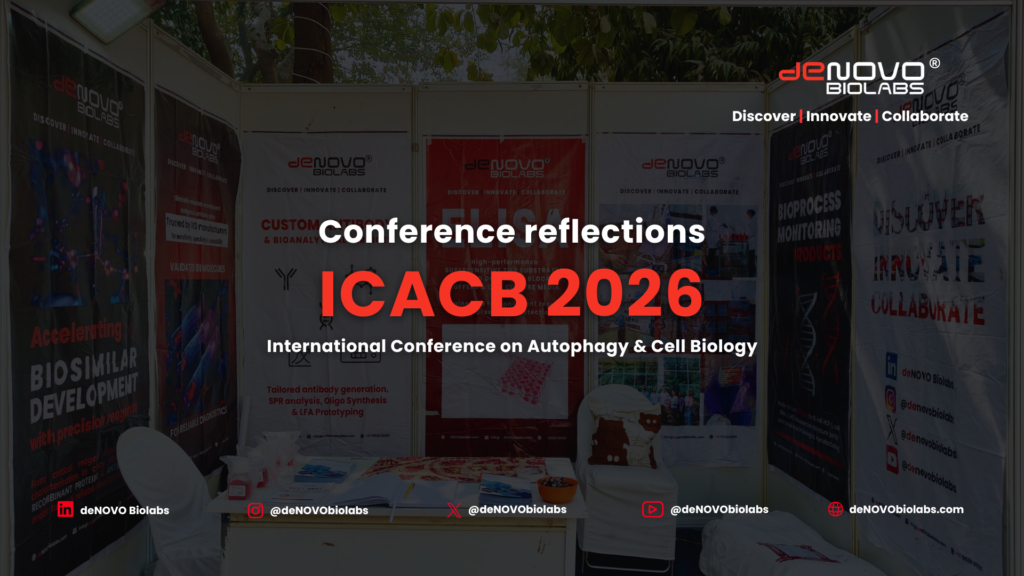
The International Conference on Autophagy and Cell Biology (ICACB 2026) brought together cell biologists, bioprocess engineers, and translational researchers around a question that keeps surfacing across disciplines: how much of what we understand at the bench actually survives the transition to development?
Attending ICACB this year reinforced something we have observed in our own work at deNOVO – the gap between fundamental cell biology and applied biotech is not primarily a knowledge gap. It is a tools gap, a measurement gap, and sometimes a language gap. Scientists and developers are often working from the same biology, but not yet from the same data.
Here is what stood out to us.
1. Autophagy as QC (Biopharma POV)
A recurring thread at ICACB was the role of autophagy – particularly macroautophagy and selective autophagy – in cellular protein quality control. When a cell encounters misfolded or aggregated proteins, autophagy is one of the primary mechanisms for clearing them before they cause wider damage.
In the context of CHO (Chinese Hamster Ovary) cell culture, the workhorse of biologic manufacturing – this has direct implications. CHO cells under production stress, nutrient limitation, or dissolved oxygen fluctuations activate autophagy pathways as a survival mechanism. What happens to your therapeutic protein during that process is not always predictable.
Protein aggregation is already one of the most scrutinized quality attributes in biosimilar development. It is a regulatory concern, a comparability concern, and a patient safety concern. Connecting the upstream cell biology – the conditions that trigger autophagy, the timing, the degree of lysosomal activity – to downstream product quality is a frontier that is still largely unmapped for most production platforms.
2. Lysosomal Biology Sessions
Lysosomal biology featured prominently in multiple presentations – not just in the context of lysosomal storage disorders, but in terms of how lysosomal function affects protein processing, receptor trafficking, and antibody internalization in therapeutic contexts.
For antibody developers, this raised practical questions:
- Antibody-drug conjugate (ADC) design:
Lysosomal pH and cathepsin activity directly affect linker cleavage efficiency, and by extension, therapeutic window. - Receptor downregulation studies:
LLysosomal degradation pathways determine how quickly cell-surface targets are cleared after antibody binding — critical for ADCC-based and receptor-blocking mechanisms. - Immunogenicity risk assessment:
Lysosomal antigen processing influences how immune cells present peptide fragments derived from biologic drugs, contributing to anti-drug antibody (ADA) formation risk.
None of these are new ideas, but the clarity of mechanism presented at ICACB, especially around LC3-associated phagocytosis (LAP) and selective autophagy receptors like p62/SQSTM1 and NDP52 – showed how much more granular the field has become. The tools needed to study these mechanisms in a therapeutic context have to keep pace.
3. The Reproducibility Problem
A session on assay reproducibility in cell biology research surfaced a tension that we at deNOVO know well. The cell biology literature has made enormous progress in understanding autophagy regulation. But converting those insights into reproducible, validated assay workflows for applied settings remains a persistent challenge.
Several factors were flagged:
- Reagent variability:
Antibodies targeting autophagy markers (LC3B, Beclin-1, ATG proteins) vary substantially in specificity and sensitivity across suppliers and lots. What reads as “autophagic flux” in one lab may not reproduce in another. - Assay context-dependence:
Many autophagy readouts validated in 2D culture behave differently in 3D models, suspension culture, or under bioreactor-like conditions. - Endpoint selection:
LC3 puncta counting, p62 degradation, and autophagic flux assays each answer a different biological question. Using the wrong readout leads to correct data but incorrect conclusions.
Inconsistent reagents mean inconsistent data, which means inconsistent decisions about cell health, process parameters, and ultimately product quality.
4. Translational Cell Biology
Perhaps the most honest theme at ICACB 2026 was acknowledgement of the translation gap – the difficulty of moving cell biology insights into product development workflows without losing scientific integrity along the way.
In biologic development, this often shows up as:
- Cell line development:
Selecting clones based on productivity without fully characterising the intracellular conditions (including autophagic status) that determine long-term genomic stability and protein quality. - Process development:
Designing fed-batch or perfusion strategies without robust analytical tools to monitor cell health parameters beyond viability and productivity. - Scale-up:
Discovering that cell behaviour at 5L or 200L bioreactor scale diverges from bench models in ways that no amount of flask-scale data could have predicted — because the relevant biology was never measured.
5. Reagent and Assay Design
Attending ICACB this year reinforced where deNOVO operates. That is at the intersection where biology meets measurement.
Our work in:
- Validated antibody development — including markers relevant to cell health, protein quality, and immune response
- Custom ELISA development for bioanalytical applications in biologics and biosimilars
- Cell-based assay design for drug characterisation and immunogenicity assessment
- Recombinant protein production and QC reagent supply
…sits directly within the challenges ICACB 2026 highlighted. The biology being described in presentations needs tools that can accurately, reproducibly capture it — in a lab context, a process context, and eventually a regulatory context.
We build tools for labs that cannot afford for their reagents to be the weakest link in the chain. That commitment has not changed since 2013 and conferences like these remind us why it matters.
Final Thought
Fundamental biology conferences often get written off by industry as too academic. ICACB 2026 proved that wrong. The questions being asked about autophagy, lysosomal function, and cellular stress responses are directly relevant to how CHO cells behave in your bioreactor, how your antibody is processed after cell binding, and how consistent your lot-to-lot results will be.
The scientists in that room are working on the biology that will eventually define the next round of quality standards and analytical expectations in biologics development. Paying attention to that work, and building tools that can support it – is part of what it means to take quality seriously.
If your team is developing biologics, biosimilars, or cell-based assays and needs a partner who understands both the biology and the measurement challenges, let’s chat.