
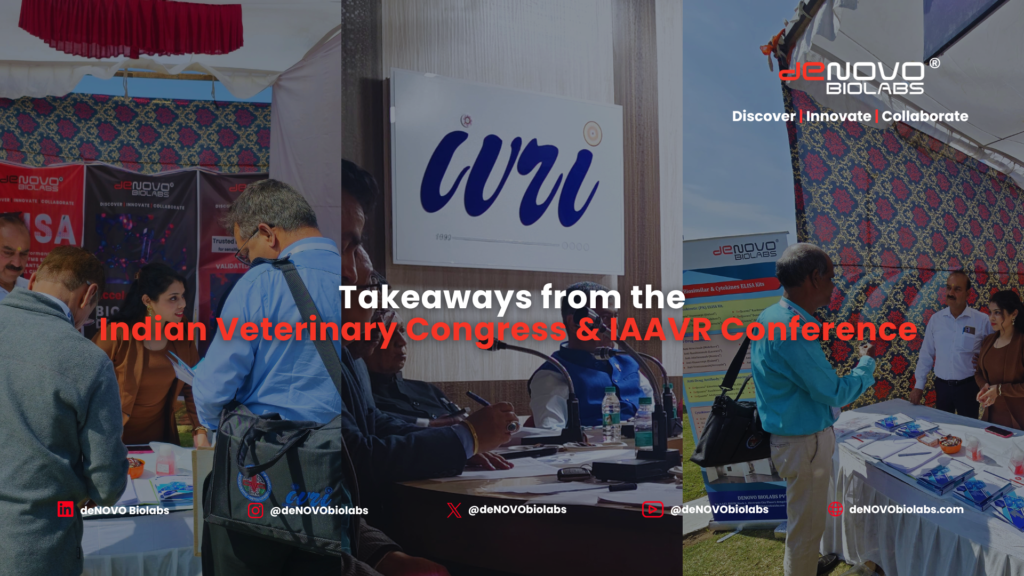
The 26th Indian Veterinary Congress convened at ICAR-IVRI Izatnagar on February 12-13, 2026, with a theme that signals where veterinary science is heading: “Progress and Emerging Trends in Animal Health and Production including Poultry and Wildlife in the Global Context”.
Alongside this, the upcoming BASiC-2026 (Bhartiya Animal Science Conclave, March 8-9, 2026) will extend these conversations under the theme “Tradition to Technology: The Bioscience Pathway to Viksit Bharat 2047” .
At deNOVO Biolabs, our work in human biopharma diagnostics—recombinant antigens, validated ELISA platforms, and cryopreservation—gives us a unique vantage point on these developments.
The technical challenges in veterinary diagnostics are remarkably parallel to those we solve in biosimilar development and clinical assay validation.
Here is what mattered at IVRI 2026, viewed through the lens of precision biological manufacturing.
1. From Tradition to Technology:
The “Tradition to Technology” theme at BASiC-2026 emphasizes documentation and validation of Indigenous Technical Knowledge (ITK) using scientific methods . This mirrors a challenge we understand intimately: translating empirical knowledge into reproducible, standardized assays.
The technical reality:
- Ethno-veterinary practices require rigorous validation through immunological assays before integration into formal veterinary systems
- Herbal and bio-based interventions need standardized reference materials for batch consistency
- Quality control for traditional formulations demands the same analytical rigor as synthetic pharmaceuticals
At deNOVO, we engineer recombinant proteins and validate antibody pairs for ELISA platforms—capabilities directly applicable to standardizing traditional veterinary formulations. When indigenous knowledge meets validated assay platforms, the result is enhancement, not substitution .
2. One Health demands Cross-Species Diagnostic Platforms
The One Health framework dominated IVRI 2026 discussions, linking human, animal, and environmental health . With zoonotic diseases requiring surveillance across species boundaries, the Congress emphasized integrated monitoring systems.
Technical requirements emerging from the Congress:
- Multiplex diagnostic platforms capable of detecting pathogens across human and animal hosts
- Standardized reagents that perform consistently across diverse matrices (serum, plasma, tissue)
- AMR (Antimicrobial Resistance) surveillance with traceable reference standards
Our experience developing PK/immunogenicity ELISA kits for human biosimilars translates directly here. The same principles of assay validation—matrix compatibility, lot-to-lot consistency, and regulatory documentation—apply whether you are monitoring drug levels in human patients or tracking zoonotic pathogens in livestock .
3. Livestock farming requires Precision Reagents
The integration of AI, sensors, and big data into livestock management is accelerating. However, digital tools are only as reliable as the biological reagents they analyze—a point emphasized in the Congress’s focus on precision livestock farming .
Critical gaps identified:
- Early disease detection requires high-sensitivity immunoassays
- Genomic selection programs need validated biomarker panels
- Climate-resilient health monitoring depends on stable reference materials
High-fidelity reagents become non-negotiable when algorithms make real-time decisions about animal health. Inconsistent antibodies or degraded antigens create noise that machine learning cannot filter out. Our cryopreservation infrastructure ensures that reference standards maintain viability and performance across longitudinal studies—a capability we have validated in human clinical trials and can extend to veterinary applications .
4. The Atmanirbhar Imperative in Biologicals
The Congress reinforced what we have championed since 2013: India needs domestic capabilities in critical biological reagents. Discussions around vaccine development, diagnostic commercialization, and anti-snake venom production emphasized reducing import dependencies .
Practical pathways forward:
- Local production of recombinant proteins for assay development
- Cryopreservation infrastructure for maintaining reference cell lines
- Standardized assay development meeting both Indian regulatory requirements and global standards
With ISO 9001:2015 and ISO 13485 certification, deNOVO manufactures ELISA kits and recombinant proteins that serve Indian CROs, biopharma companies, and diagnostic developers . The veterinary sector can leverage this existing infrastructure rather than building parallel import-dependent supply chains.
5. AMR surveillance needs Standardized Detection
Antimicrobial resistance emerged as a priority area, with calls for standardized resistance detection methods. The technical sessions emphasized that surveillance without validated detection methods produces incomparable data .
What effective AMR monitoring requires:
- Consistent lot-to-lot quality in detection reagents
- Bridging studies comparing assay performance across platforms
- Regional manufacturing to ensure supply resilience
Our approach to biosimilar ELISA validation—where we test for short-term stability, reagent storage compatibility, and QC material traceability—directly applies to AMR surveillance kits. Surveillance systems built on unstable reagents generate artifacts, not actionable intelligence .
The Road Ahead
IVRI 2026 made clear that the future of animal health in India is precision-driven, data-enabled, and domestically anchored. The gap between “Tradition to Technology” and “Viksit Bharat 2047” will be bridged by diagnostics that are reliable, scalable, and scientifically rigorous, regardless of whether the patient has two legs or four.
At deNOVO Biolabs, our capabilities in human diagnostics have direct application to veterinary challenges:
- Recombinant antigen engineering for infectious disease detection
- Custom antibody development supporting surveillance initiatives
- Assay reagent stabilization for point-of-care deployment
- Cryopreservation services ensuring long-term viability of biological materials
These are active capabilities supporting Indian researchers today. The technical standards we maintain for human biosimilar development—purity >95%, minimal aggregation, low host contaminants—are the same standards veterinary diagnostics require .
If your team is building the next generation of veterinary diagnostics, scaling immunoassays for livestock health, or navigating assay validation for animal health applications, the technical infrastructure exists in India.
Reach out to us at info@denovobiolabs.com
We partner with research institutions, diagnostic developers, and biopharma innovators to deliver not only reagents but also reproducible reliability for precision health applications.