
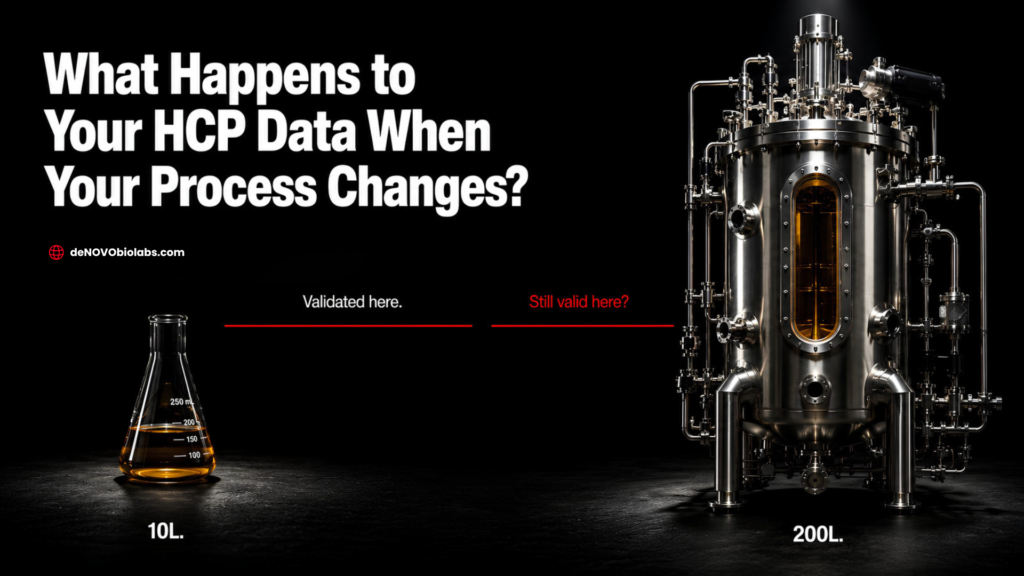
Scale-up is the moment a biosimilar program starts feeling real. Moving from a 10L bench-scale fermentation to a 200L pilot run is a tangible sign that the program is progressing. The process team reviews yield data. The purification team checks clearance logs. And in most programs, the analytical team continues running the same HCP assay that was validated months earlier against bench-scale material.
The assumption that a validated assay transfers automatically to the new scale is one of the more quietly expensive mistakes in biosimilar development.
Why HCP profile changes with process change?
Host cell proteins are not a fixed population. They are the proteins expressed by your E. coli culture at a particular point in time, under particular conditions. Change the conditions and you change the population.
At bench scale, a 10L bioreactor gives you relatively homogeneous culture conditions. pH, dissolved oxygen, temperature, and nutrient gradients are small and controllable. At 200L, those gradients become significant. Cells at different positions in the bioreactor experience different microenvironments. The stress responses that E. coli mounts to deal with those variations affect gene expression, and gene expression affects which proteins are produced and at what levels.
The result is that the HCP profile of your 200L pilot batch is not identical to your 10L development batch. It is related. It may be similar. But it is not the same, and the regulatory framework does not allow you to assume equivalence without data.
What counts as a process change trigger?
Regulatory guidance from EMA, FDA, and CDSCO identifies several categories of change that require analytical reassessment. For HCP testing, the practical trigger list includes fermentation scale changes, modifications to downstream purification steps such as column type, resin, load density or gradient conditions, buffer or excipient changes in your formulation, changes to your expression construct or host strain, and significant changes to cell culture media composition.
Each of these changes has the potential to alter either the HCP profile being generated or the matrix in which your assay is running, or both. An HCP kit validated against your development-scale process material in your development-scale formulation buffer is validated for exactly that combination of conditions. Change either variable and the validation data needs to be extended to cover the new state.
What does revalidation involve?
The scope of analytical bridging work depends on the nature and magnitude of the change. Not every scale-up requires a complete revalidation from scratch. But every scale-up requires an honest assessment of what has changed and what that means for your existing data.
The minimum for a scale-up bridging study typically includes a comparative HCP profile assessment between development and pilot scale material, confirmation that matrix recovery is within acceptance criteria in the new process matrix, and an updated antibody coverage study if the purification sequence has changed significantly.
The antibody coverage assessment is the step that gets skipped most often, and it is the one that causes the most problems. If you ran an Antibody Affinity Extraction study during your original validation and achieved 80% coverage against your development-scale HCP material, that result belongs to that material. Running the same kit against pilot-scale material from a modified purification sequence and claiming equivalent coverage without new data is a gap that reviewers consistently identify.
Conversely, if your AAE study at pilot scale shows the same coverage level, you have a strong data package that explicitly connects your validated assay to your commercial-scale process. That is a significantly more defensible regulatory submission.
Process changes that are not scale-up:
Scale-up gets the most attention because it is the most visible process change. But HCP revalidation triggers happen throughout the development lifecycle.
A change in column resin during purification optimisation can alter selectivity. A new lot of cell culture media with a different composition can affect which HCPs are present in the harvest. A buffer change made to improve formulation stability can affect spike-and-recovery results in ways that were not anticipated. Each of these changes is smaller than a full scale-up but each of them touches the HCP testing picture.
The discipline that protects programs from being surprised by these changes is treating every process modification as a question about analytical method validity, not just a process optimisation decision. Before the change is implemented in a batch that will generate regulatory data, the analytical team should have assessed whether the change is likely to affect the HCP assay and what data will be needed to confirm validity after the change.
The DeQuanto E. coli HCP ELISA kit
At deNOVO Biolabs, our E. coli HCP ELISA kit is built to support teams across the full development lifecycle. Detection range 1.95 to 500 ng/mL, LLOQ approximately 1.95 ng/mL, validated for BL21, DH5α, JM109, TOP10F, K12, and MC1061 strains, CV below 15% intra-assay and below 20% inter-assay, 96-well strip plate format. Manufactured at our ISO-certified facility in Electronics City, Bangalore. Delivered across India in 1 to 2 weeks.
If your biosimilar program has reached a scale-up milestone or is approaching one, write to us to discuss what the HCP bridging work should cover before your regulatory submission.
📧 info@denovobiolabs.com
📞 +91 80 29575711
🌐 www.denovobiolabs.com