
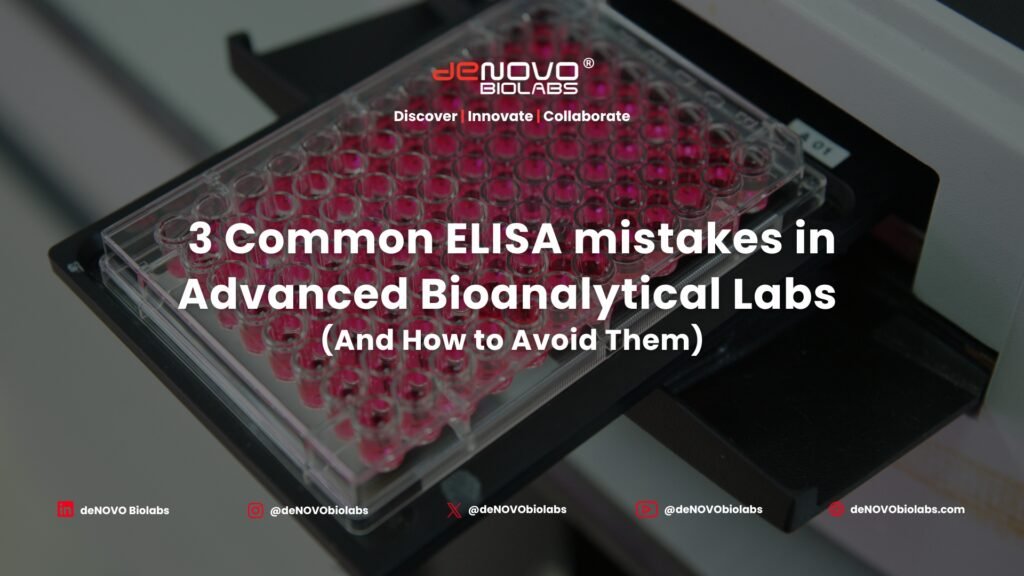
Published by deNOVO Biolabs — Insights from the frontlines of biotech, diagnostics & assay development.
Introduction
Enzyme-Linked Immunosorbent Assays (ELISAs) are foundational to bioanalytical workflows, especially in pharmacokinetics (PK) studies, immunogenicity assessments, and diagnostics. With decades of use across life sciences, ELISA remains one of the most reliable methods for quantifying proteins and antibodies in complex matrices. But even in advanced bioanalytical labs, subtle mistakes still compromise data quality and those errors often aren’t obvious until late in a study.
In this article, we explore three common ELISA mistakes that experienced scientists still encounter, why they persist, and practical strategies to address them grounded in operational realities and high-quality assay design.
Mistake #1: Prioritizing Sensitivity over Performance
One of the most pervasive assumptions in assay design is the idea that higher sensitivity equals better results. While high analytical sensitivity is desirable, particularly in PK and ADA (anti-drug antibody) studies where low limits of quantification are needed. It does not automatically translate to consistent, reproducible data.
Why this happens?
Labs often pursue ultra-low detection limits to capture trace analytes, especially in regulated biosimilar programs. However, overly sensitive assays may exhibit:
- Increased background noise
- Narrow dynamic range
- Variable matrix effects
- Reduced robustness across multiple runs
These issues can make results unpredictable, particularly when assays are extended to diverse sample sets or different operators. In practice, balancing sensitivity with reproducibility is critical — otherwise, data that looks sensitive can become unreliable under real laboratory conditions. (Abyntek)
How to avoid it?
Best-practice labs evaluate sensitivity in the context of whole-assay performance:
- Run assays across multiple conditions (different matrices, replicates)
- Evaluate signal-to-noise ratios, not just detection limits
- Prioritize consistent performance over raw sensitivity
Mistake #2: Finalizing Assay Design Early
Another recurring issue even in expert labs. It is prematurely locking in ELISA conditions and then assuming they will scale seamlessly. Early assay conditions might perform well during initial development, but they can fail when confronted with increased sample volume or changing study requirements.
Why this happens?
When early feasibility data looks adequate, pressure to meet timelines can lead teams to halt optimization prematurely. However, what “works” initially may not hold across broader workflows.
Common downstream effects include:
- Unexpected hook effects at higher analyte concentrations
- Shifts in standard curves
- Increased failure rates during validation
- Last-minute method adjustments, which are expensive and disruptive to timelines
Troubleshooting at this stage consumes valuable time and resources — time that could have been saved with controlled optimization earlier. (Abyntek)
How to avoid it?
Labs with disciplined ELISA development workflows treat assay design as an iterative process. Instead of locking parameters early:
- Conduct stress testing with real samples
- Evaluate assay performance across anticipated workflow variations
- Ensure conditions are robust before official validation
Mistake #3: Ignoring Lot-to-Lot Variability
Consistency between reagent lots is essential for long-term bioanalytical reliability. However, many labs only validate an ELISA using a single lot of reagents — assuming future lots will perform identically.
Why this happens?
Reagent variability — whether in antibody affinity, enzyme activity, blocking agents, or substrates — can introduce shifts in signals, background noise, or overall assay behavior. These differences are often subtle until they emerge mid-study, leading to revalidation requirements or compromised data sets.
ELISA plate quality and batch consistency itself may also influence performance, as manufacturing differences in surface treatment and plate uniformity can affect binding efficiency, background, and reproducibility. (GenFollower)
How to avoid it?
Advanced labs mitigate this risk by:
- Assessing multiple reagent lots during assay development
- Including lot bridging strategies in validation plans
- Choosing suppliers with strong quality controls and documentation
Why these mistakes matter for Bioanalysis?
ELISA assays are more than assays — they are decisions. Every choice in design, optimization, and reagent selection influences data outcomes, regulatory readiness, and project timelines. When these decisions are misaligned, downstream consequences include:
- Increased rework and cost
- Delays in validation or regulatory submissions
- Reduced confidence in data quality
deNOVO Biolabs: Your Partner in Reliable ELISA Development
As the first Indian company to manufacture ELISA kits for global pharmacokinetics and immunogenicity studies, deNOVO Biolabs brings deep technical experience and practical expertise to assay development and optimization.
Our Capabilities include:
- Validated ELISA Kits for PK, ADA, cytokines, and small molecules
- Custom assay development tailored to study needs
- High-quality antibodies & recombinant proteins
- Comprehensive support services from design to validation and beyond
Whether your team needs a robust primary assay or a custom ELISA workflow for emerging biomarkers, we help ensure data you can trust.
Takeaway
Advanced labs don’t avoid all ELISA pitfalls — but they recognize them early, plan for them deliberately, and address them with evidence-driven decisions. Balancing sensitivity with reliability, allowing optimization to mature before lock-in, and proactively managing reagent variability are keys to better outcomes.
If you’d like assistance optimizing your ELISA assays or selecting the right tools for complex bioanalytical studies, reach out to the deNOVO team.
Ready to elevate your ELISA workflows?
Contact deNOVO Biolabs for expert consultation and tailored assay solutions that deliver consistent, high-quality data.
Buying Proxies
9 Jul 2026I gotta bookmark this website it seems invaluable very beneficial
Organic Traffic
21 Aug 2026I enjoy your writing style really enjoying this website .